Author: Kenji

  • Most of Us Say No – So HOW Do We Actually Say So?

    [TLDR: Most of us already know where we stand on drug abuse but that does not always make it easy to say so when the topic surfaces in casual conversations, especially with someone we care about. This article looks at how to hold your ground without shutting the person out, and why speaking up can still be honest, supportive and real, even if it does not sound perfect in the moment.]

    Photo of two skateboarders sitting on stairs
    Photo taken by Allan Mas on Pexels

    It is one thing to know how you feel about drugs. It is another thing entirely to say it when a friend or someone close to you starts talking like it is no big deal.

    That is where things can get tricky. Most of us do not want to kill the mood, or make a conversation feel heavier than it needs to be. But staying silent can feel off too, especially when what is being said does not sit right with us. The good news is that it does not have to be a choice between backing off completely or starting a fight.

    You Can Hold Both Things At Once

    In those moments, it’s become second nature to us to feel like we have to choose: either to support our friend or push back on what they’re doing. But not every situation is zero-sum or a compromise. We don’t have to box ourselves into a binary. We can:

    • Care about someone and be uncomfortable with their decision.
    • Stay close and still not go along with it.
    • Empathise with their position and still think it’s worth a more honest conversation.
    • Speak up in a way that still keeps the door open.

    That either/or tension isn’t a problem to resolve. We can hold both things at once: it’s a sign that we’re taking both our values and our interpersonal relationships seriously. The question is what we do with it. And that depends, in part, on how we naturally show up for the people we care about.

    How to Navigate and Respond to Such Conversations

    Most people who stay quiet in these moments might not actually be indifferent. They just don’t know how to say something without it feeling awkward or sounding preachy. But what we say, how we say it and even what we leave unsaid in those moments matters more than we think. Sometimes speaking up could be the most important thing we do for someone, and it doesn’t have to look like a formal intervention or heated debate. The goal isn’t to win – it’s to keep the dialogue open and agree to disagree. Even if nothing seems to change in the moment, an honest conversation always leaves something behind. Hearing them out doesn’t mean agreeing; it just means they’re more likely to hear us back.

    We don’t need to have the perfect answer, but going in with a clear sense of our stance makes a real difference.  Comments like “nothing happened,” “everyone does it” or “it’s legal overseas” can make drug abuse sound harmless. That is why it helps to create a pause, check what is being said; a simple question or a calm response is sometimes enough to slow things down and make people think.

    How that looks in practice depends on who we are. Some people lead with empathy. Some pressure-test with reason. Some trust their gut and draw a line. Some defuse with wit. There’s no single right approach.

    Here are 4 ways to kickstart such conversations:

    1. Start by understanding where the other person is coming from.

    • They may be repeating something they saw online, trying to sound experienced or just going along with the mood of the group.
    • This might sound like:
      • “I’m not trying to make this weird, I just care about what happens to you.”
      • “I’ve been thinking about what you said, and I can’t seem to shake it off. Can we talk about it properly?”

    2. Bring the conversation back to facts, not viral stories or one-sided takes.

    • A single experience, a funny comment, or a post with lots of likes does not prove that something is safe. If someone says “it’s legal overseas” or “everyone does it,” remember that legality and risk are still real, especially in Singapore.
    • This might sound like:
      • “Say real, what’s making this feel worth it to you?”
      • “Before you decide, can we run through what you’re actually signing up for?”

    3. Trust your gut when something feels off.

    • If a conversation feels alarmingly casual about something serious, that feeling is worth paying attention to. You do not need to have a perfect argument to know that a line is being crossed. Even if the other person does not agree right away, speaking up can still plant a seed.
    • This might sound like:
      • “Something about this feels off to me. What’s making it feel okay to you?”
      • “I’m not doing that. I’m genuinely curious though, why are you considering it?”

    4. A funny, quick reply can break the momentum and make it clear you are not buying it.

    • Keep it light, but firm enough that the point still lands. Sometimes a short line is enough to stop the conversation from drifting into normalisation
    • This might sound like:
      • “Yes, it’s legal there, but illegal back home. I don’t think the law cares that you were on ‘vacay’.”
      • You collecting passport stamps or bad decisions?”

    5. Create a space for honest conversations, where speaking up feels safe

    • Looking out for one another is not just about having the courage to speak up, it’s also about creating for others to do the same. When people feel heard, respected and not judgement, they are more likely to raise concerns, ask questions and reconsider risky decisions.
    • This might sound like:
      • “Hey, whatever you say here, stays here.”
      • “You can be honest with me. I’d rather have this conversation than pretend everything is fine.”

    More than 90% of Singaporeans want Singapore to remain drug-free. But that vast majority only counts if it is willing to say so. Online takes can feel louder than they really are. People don’t always act the same online and IRL, but that doesn’t change the impact of what we say. That’s why speaking up isn’t about having a viral comeback, it’s about knowing when, how and why our voice matters.

    We probably already know what we think. The question is whether we are ready to say it.

  • Most of Us Say No – So WHY Aren’t We Saying So?

    [TLDR: More than 90% of Singaporeans want the country to remain drug-free. But it can feel like the opposite is true in the online space. This article looks at how permissive drug views gain hegemony through the cultural lens for wider social issues, of legality, progressiveness, normalisation, curiosity and groupthink – and why knowing our capacity for influence might be the most important thing we bring to the table.]

    Image of person using mobile phone in the dark
    Photo taken by Towfiqu Barbhuiya on Pexels

    The Gap Between What We Really Think and What Gets Said Out Loud

    Here’s something that might surprise you: more than 90% of youths and adults in Singapore1 want our country to remain a drug-free society. That’s not a fringe view. That’s an overwhelming majority of the national population, and this sentiment has remained consistent across years of the survey.

    So why does it so rarely feel that way online?

    Permissive takes on drug abuse easily surface in Reddit threads, TikTok discussions, group chats and casual conversations with friends, and they tend to be loud, confident and framed as the normalised or reasonable position. Meanwhile, the majority view quietly goes unsaid. Not because people have changed their minds, but because speaking up can feel awkward, preachy or just not worth the friction and effort. However, the irony is that most of us actually want more honest and open conversations about drugs.

    That gap is worth examining, because the silence of the majority inadvertently allows narratives that normalise drug abuse to go unchallenged and gain more weight than they deserve, misrepresenting it as the consensus or even common sense. With 50% of new drug offenders arrested in 2025 under 302, this is clearly not just background noise online but part of a wider risk that continues to affect young people.

    That is where the attitude-behaviour gap, or value-action gap, shows up. We may genuinely believe in staying drug-free and keeping Singapore drug-free, but what we do in the moment does not always match what we think in principle. That does not necessarily mean people do not care. More often, it means managing ambivalence and holding two (potentially) conflicting attitudes in tension: wanting to stand for something, but also wanting to avoid imposing our views on others, or the feeling that one comment will not make much difference. Silence then gets rationalised as polite, low-risk or not worth the trouble, even when, deep down, we do think the conversation matters.

    And that gap has its own drivers and barriers. People are more likely to speak up when the issue feels personal, when they feel clear about what they want to say, or when they believe their voice can still make a difference. But there are also familiar barriers: fear of sounding preachy, uncertainty about the right words, the assumption that someone else will step in, or the quiet hope that the moment will pass on its own. That is how the silent majority stays silent — not because the belief is missing, but because the step from belief to action can feel harder than it should.

    Rethinking the Debate on Drug Legality and Acceptance in Singapore

    Online chatter can make drug abuse sound like a simple debate about what is “normal” or “acceptable.” Some argue that Singapore should be more open-minded, especially as countries move towards greater acceptance and easier access to drugs, framing our position as draconian, backward and not progressive. Others say that Singapore’s stricter stance is exactly what keeps the country safe, stable and protected from the wider fallout that drug permissiveness can bring. That contrast is worth pausing on, because it is not just about opinions online — it is about the kind of everyday life Singapore chooses to protect.

    That split is easy to see online, like Reddit.User sushiriceonly on r/askSingapore wrote:

    “Lol, as a Singaporean who’s been living overseas for 7+ years and doesn’t plan to go back to SG to live ever again… I laugh. And draconian laws like this are partially why I don’t plan on going back.”

    It reflects a broader pattern that the more exposure people have to environments where drug abuse is legal or normalised, the more Singapore’s stance can start to feel like the outlier. It is understandably human nature for curiosity about what one is “missing out on” to follow from there.

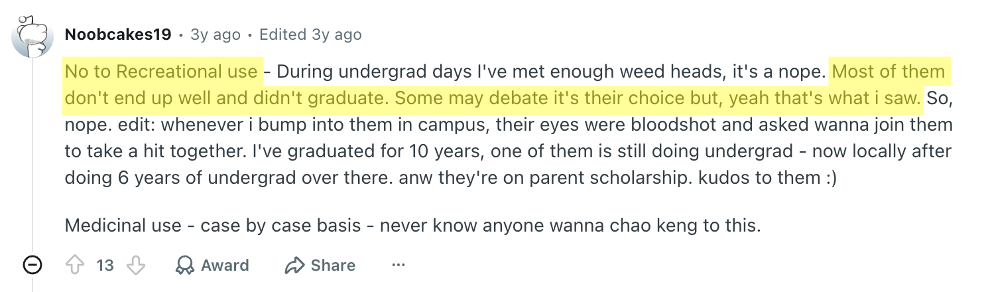
    But others push back just as firmly. Noobcakes19 on r/askSingapore said:

    What comes through in that back-and-forth is not just disagreement, but a reminder of something many Singaporeans may not always stop to think about: the safety and security we move through every day is a privilege, not a given. Being able to walk safely anywhere, let children take public transport independently, or go about daily life without worrying about the social fallout of drug legalisation are things many of us may have come to take for granted.

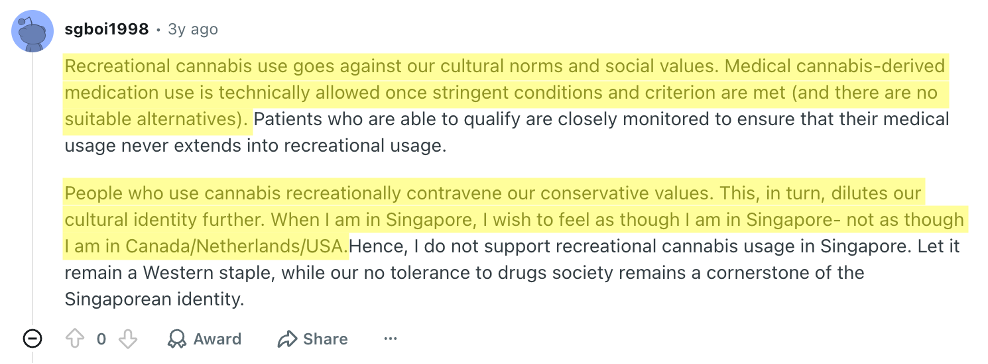
    That is why comments like sgboi1998 on r/askSingapore resonates:

    Singapore’s drug-free stance is, in fact, a values-based position that more than 90% of Singaporeans actually share, and not a failure to progress. And that is really the point. The countries most often held up as model examples of drug legalisation are still navigating significant social and economic costs, with communities dealing with the downstream effects of easier access. What gets called progress in one context can look very different when we examine the outcomes. Singapore’s drug laws are not just drawing a legal line, they protect the kind of everyday life that many other societies are still trying to get back.

    That is why the gap matters. If the majority of us wish for our own society to stay drug-free, then the real issue is not whether the majority exists, but whether it shows up when the conversation gets uncomfortable. When the loudest voices online frame drug abuse as progress or the norm, silence can start to look like agreement. And over time, that is how a clear and deeper values-based position gets blurred into something that seems far more divided than it really is.

    Reference articles:
    1 National Drug Perception Survey 2025 – National Council Against Drug Abuse
    2CNB Annual Statistics Report 2025 – Central Narcotics Bureau

  • Cannabis: The Hype, The Lies and The Influence

    Cannabis: The Hype, The Lies and The Influence

    [TLDR: Discover how savvy marketing, profit-driven industries, and celebrity endorsements have transformed cannabis from a criminal taboo into a celebrated cultural trend in parts of the world. Behind the hype lies a hidden cost — know the facts, stay sharp, stay uninfluenced.]

    Photo taken by Alex Ware on Unsplashed

    The Creeping Influence of Pro-Cannabis Narratives

    Have you noticed how casually the words “weed” or “marijuana” are thrown around these days? Pop culture has normalised cannabis abuse through  the songs we hear, the movies we watch and even the  celebrities we idolise.1 What’s less visible is the calculated industry effort behind this normalisation – cannabis has been rebranded as a “sophisticated” lifestyle choice through clever marketing, using food and flavour-inspired references to promote positive sensations.2 These are just some examples of carefully crafted messaging to distance cannabis from its harmful reality. 

    As neighbouring countries decriminalise cannabis abuse, many might start thinking, “It’s not such a big deal, right?”

    But here’s the truth: the cultural normalisation of cannabis is causing a serious impact – it is changing our views on drugs. Despite Singapore’s stringent drug laws, young people below 30 continue to form the largest proportion among both total cannabis abusers arrested and new cannabis abusers arrested at 49% and 57%, respectively.3 

    The Truth About Cannabis

    Photo taken by Eugene Golovesov on Pexels

    Abusing cannabis has real costs that go beyond just the purchase price.  

    In the short term, cannabis can cause impaired learning, memory loss, shortened attention, poor motor coordination, and risky decision-making.4 These aren’t just minor effects – they interfere with our ability to think, plan, and solve problems.5 And the potential collateral damage caused by impaired cognitive function? Think derailed educational and career opportunities, among others. 

    Over time, these effects worsen. Drug abuse has long-term consequences that extend far beyond the individual, and can cause emotional and social fallout.6 

    “(Referring to the ease of relapse) Just a small temptation, a sneaky opportunity, a brief moment of weakness and everything you have worked hard for would have gone down the drain. The battle is ongoing, a lifelong commitment to staying clean,” said Dr. (HC) Riduan Ishak. “Never start,” he advised.7 

    Contrary to popular narratives, cannabis is not the wellness wonder you’re told of. Despite what is being pushed in the media, the scientific evidence supporting claims of cannabis for medical use currently remains limited and inconclusive.8

    Stay Informed, Stay Uninfluenced

    As pro-cannabis narratives continue to grow louder, it’s easy to start wondering, “Maybe cannabis is different… maybe it’s not as harmful as they say.” But that’s exactly what the marketing wants you to believe.

    Let’s learn to recognise the influences surrounding us and rethink the narratives we consume. 

    Reference articles:
    1 How cannabis and alt beverage brands can thrive despite marketing hurdles
    2 Marijuana ads are enticing kids to try weed, study says
    3 Singapore Drug Situation Report 2024
    4 Cannabis and Brain Health
    5 Using marijuana may affect your ability to think and plan, study says
    Families, loved ones of drug abusers suffer from emotional, social fallout of addiction: Social workers
    7 Our Flawed Journeys by Architects of Life
    8 Heart of the Matter podcast: Unpacking young people’s misperceptions about cannabis

  • The Unfiltered Truth on Drugs: 3 Lies About Drug Abuse  

    The Unfiltered Truth on Drugs: 3 Lies About Drug Abuse  

    [TL;DR: Could drug abuse ever be okay? Think again.
    We break down three common misconceptions about drugs that surround us today, revealing how the drug industry targets us and uses sophisticated marketing to normalise harmful substances. Understanding these tactics helps you stay uninfluenced and see the real facts when it comes to drugs.] 

    Person using smartphone
    Photo taken by Rob Hampson on Unsplash

    You probably have encountered mixed messages about drugs online, in the media you consume, or even through conversations with friends. As drug legalisation spreads globally and marketing becomes increasingly sophisticated, it is harder than ever to separate fact from fiction. Drug companies and their advocates know this, and are specifically targeting younger consumers.

    Let’s expose three common lies about drugs that are being pushed through clever marketing, social pressure and misinformation.

    Myth #01: “It’s Fine As Long As You Don’t Overdo It”

    It’s fine as long as you don’t overdo it.

    or

    Some drugs aren’t harmful, they can actually be beneficial.

    If you search the terms “raw cannabis” or “microdosing psychedelics” online today, you may find many articles that promote such views. Some are even disguised as wellness or lifestyle content.

    However, this contradicts scientific research that consistently show that any form of cannabis has impact on health and well-being – from impairing attention, memory and decision-making to affecting cognitive function, which increases the risk of accidents and harm.1, 2 

    The notion that “just trying it once” is harmless oversimplifies addiction, which can develop unpredictably based on factors like genetics, mental health, and trauma.

    Silhouette of 2 Person Standing in Front of White and Black Stripe Wall
    Photo taken by Cottonbro Studio on Pexels

    Myth #02: “My Body, My Choice”

    “My body, my choice” is a common refrain. It frames drug abuse as a matter of personal choice and liberty. But this framing ignores how our decisions are shaped by powerful commercial interests that profit from individualistic messaging while downplaying societal impacts. Behind the “freedom of choice” narrative lies sophisticated cultural shifts that have redefined recreational drug use as progressive and open-minded, making those who question these norms feel judgmental or outdated.

    What’s rarely discussed is how privilege can shape these “personal” choices. Those with economic advantages, supportive families, and access to healthcare often approach drug experimentation with a false sense of immunity to consequences. This privileged perspective ignores how their choices influence others—especially peers with fewer resources, unstable home environments, or existing mental health challenges who may face far more severe consequences for the same choices.

    So, is drug abuse truly a “personal choice”? Your social circles can gradually normalise behaviours you once rejected, while your “personal” choices can become the justification for others to make potentially more harmful decisions in different circumstances.

    Myth #03: “If It’s Legal, It Must Be Okay”

    As more countries legalise drugs, a dangerous perception grows with the phenomenon: if it’s legal, it can’t be that harmful. This again is an oversimplification that ignores the complex factors behind legalisation decisions and the mounting evidence of negative consequences.

    What’s driving legalisation isn’t purely public safety but profit. And cannabis firms are taking pages directly from the Big  Tobacco marketing playbook to hook young consumers. For example, in 2018 alone, North America’s cannabis industry spent US$661 million on marketing campaigns and spends are projected to increase to 3.89 bn 10 years later.3

    Behind the scenes in America, power brokers have marketed marijuana as a cure-all to shape public perception, paving the way for widespread acceptance and profitable growth of the recreational cannabis market.4 Furthermore, the utilisation of social media and influencers to promote their products to young, impressionable audiences, makes cannabis increasingly enticing.4

    Countries that have legalised drugs often experience devastating societal impacts. In the United States, which was one of the first countries to legalise cannabis, research shows negative impacts on adolescent health alongside increased healthcare and social costs.

    Navigating a Complex World of Influences

    Your future is worth protecting. By understanding the tactics used to market and normalise drugs, you gain the power to make truly informed decisions based on facts. Stay curious, question what you see, and choose a path that genuinely serves your well-being and goals.

    Reference articles:
    1  Alcohol, Drugs and Addictive Behaviours
    2  Cannabis Health Effects
    3 Cannabis ad spending in North America 2018-2030
    4 Smokescreen: What the marijuana industry doesn’t want you to know” By Kevin A Sabet, President and CEO of Smart Approaches to Marijuana (SAM) and Foundation for Drug Policy Solutions (FDPS)